

Claude Sonnet 5.5 vs GPT-6: Which Model Should You Actually Use?
We compared Claude Sonnet 5.5 with the GPT-6 family the practical way: official price cards, the benchmark tables both labs publish, and the most-watched independent head-to-heads of launch week. Sonnet 5.5 arrived on September 28, 2026, reportedly near Opus 5.5 performance at about $2 per million input tokens; OpenAI answers with Astra, Sol and Luna across three price tiers. Sixteen steps below cover pricing, benchmarks, a verdict against each GPT-6 model, and a setup you can rerun yourself. Anything marked "reportedly" rests on launch-day coverage — test before you commit.
Source & credits
Screenshots in this guide are captured from Nate Herk | AI Automation's public walkthrough video. Every step links back to the exact moment it shows, so you can follow along.
Nate Herk | AI Automation ↗The 60-second verdict
- 1
Meet Claude Sonnet 5.5, Anthropic's new value flagship
Anthropic put Sonnet 5.5 at the top of the Claude 5.5 family on September 28, 2026, pitching near-Opus 5.5 benchmark performance at a fraction of the price. The launch card above is the whole thesis: this is the model most people should run most of the day. Anthropic also says it completes the same tasks about 30% cheaper than Opus 5.5, because the model is faster and needs fewer tool calls — a claim worth testing against your own workload.
Anthropic's launch teaser for Sonnet 5.5, released September 28, 2026.Watch at 0:09 - 2
Know your three GPT-6 opponents: Astra, Sol, Luna
"GPT-6" is a family, not one model. OpenAI's welcome post introduces all three: Astra, "our most intelligent model for the best results," at $10 per million input tokens; Sol, "complex coding and professional work at a lower cost," at $2; and Luna, "fast and efficient everyday work at scale," at $0.10. Sol and Luna arrived on September 22 with prices OpenAI says are 50% below GPT-5.6 promotional pricing. Which one you compare against Sonnet 5.5 changes the whole answer.
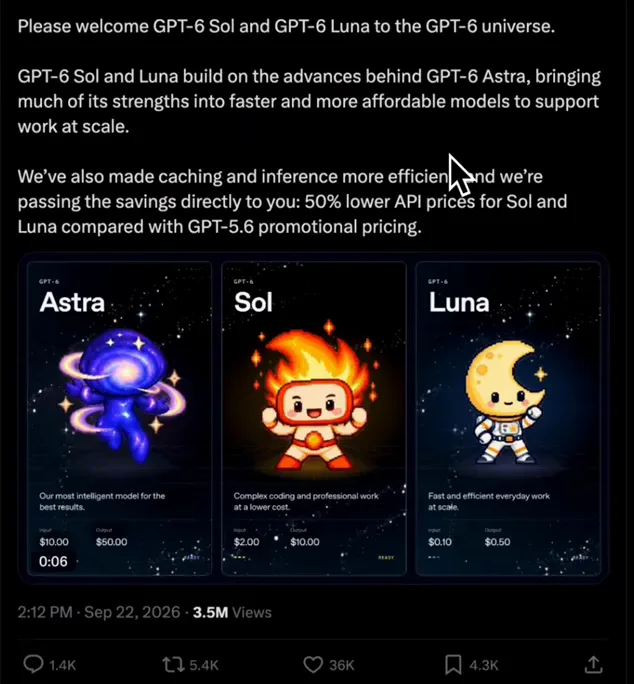
OpenAI's September 22 post pricing Astra, Sol and Luna side by side.Watch at 6:48
What each model actually costs
- 3
Anchor Claude's prices before you compare
Claude pricing is public and simple. The official card shows Opus 5.5 at $4 per million input and $20 per million output tokens, with cache reads at $0.20 — each figure below Opus 5. Sonnet 5.5 is not on this card, but launch coverage puts it at roughly $2 per million input, unchanged from Sonnet 5. Treat that as reported until Anthropic's model page confirms it; either way, it lands Sonnet 5.5 exactly in GPT-6 Sol's $2 price tier.
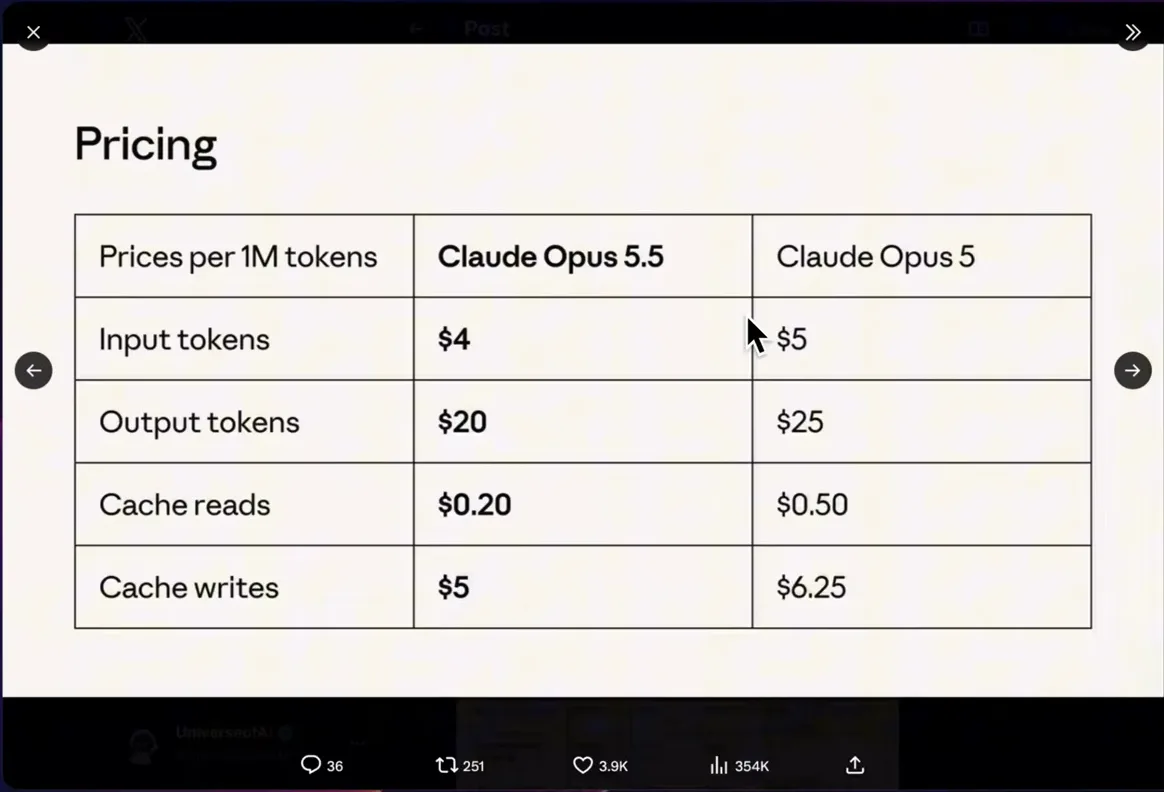
Anthropic's own pricing table: Opus 5.5 cut to $4/$20 per million tokens.Watch at 3:20 - 4
Put both price tags on one screen
The cleanest launch-week card compares the two families directly: Claude Opus 5.5 at $4/$20 per million tokens on the left, GPT-6 Sol at $2/$10 on the right. If Sonnet 5.5 really ships at about $2 in, Anthropic's workhorse lands at half of flagship Astra ($10/$50) and level with Sol, while Luna undercuts everyone at $0.10/$0.50. Price alone no longer decides this fight — which is exactly why the rest of this page exists.
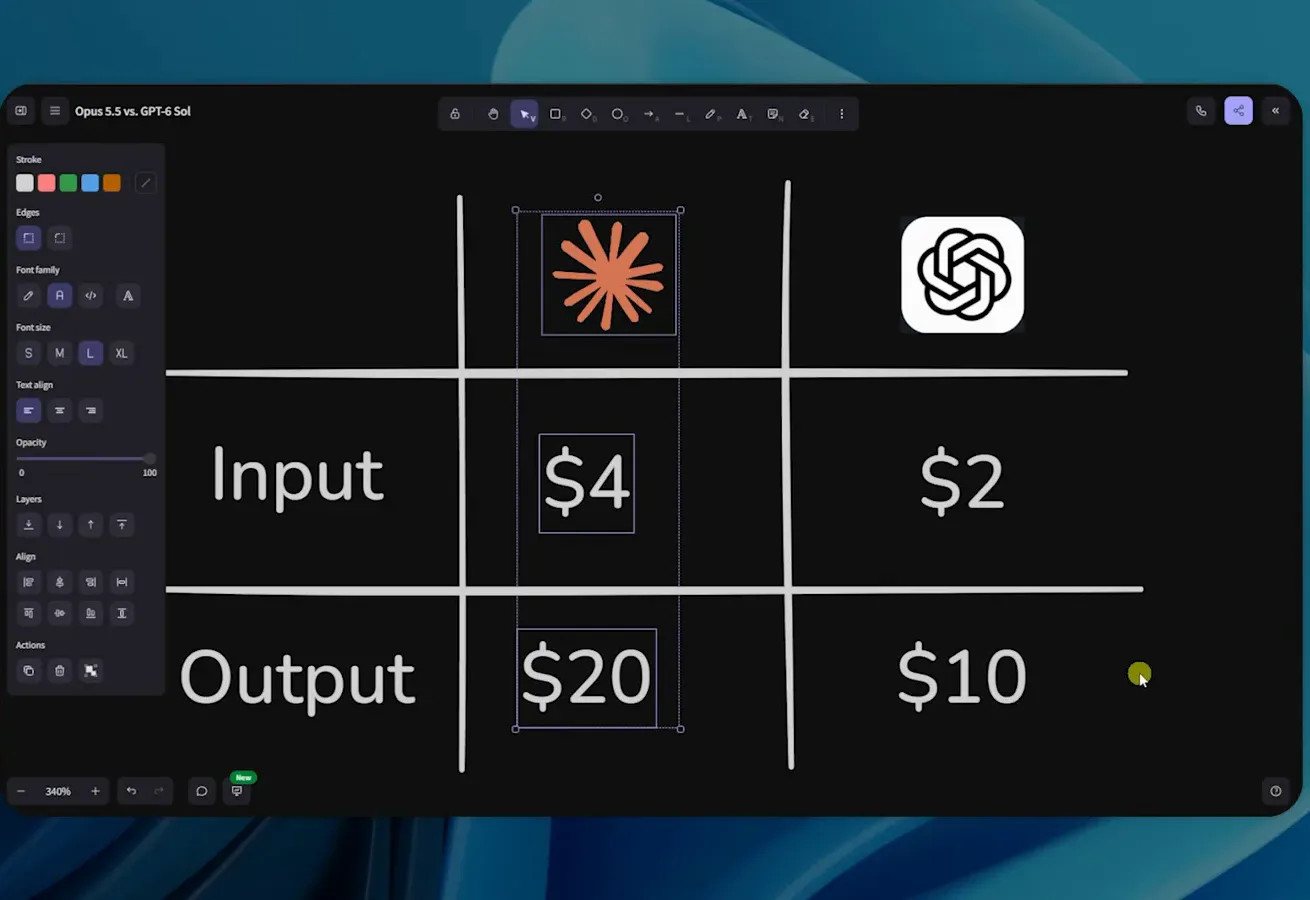
Launch-week price card: Opus 5.5 at $4/$20, GPT-6 Sol at $2/$10.Watch at 0:40
The benchmark reality check
- 5
Read the benchmark table both labs point at
Anthropic's launch table is the fastest way to see where the families trade wins. Opus 5.5 leads agentic coding (66.4% on Terminal-Bench 4.0 versus GPT-6 Astra's 57.9%), knowledge work (1846 versus 1542 on GDPval-AA) and computer use (81.8% on OSWorld 2.0), while Astra keeps agentic scientific research (64.6% versus 58.7%) and edges business workflows (41.4% versus 40.0%). Sonnet 5.5 reportedly lands near these Opus numbers at half the price — the claim your own evals should check first.
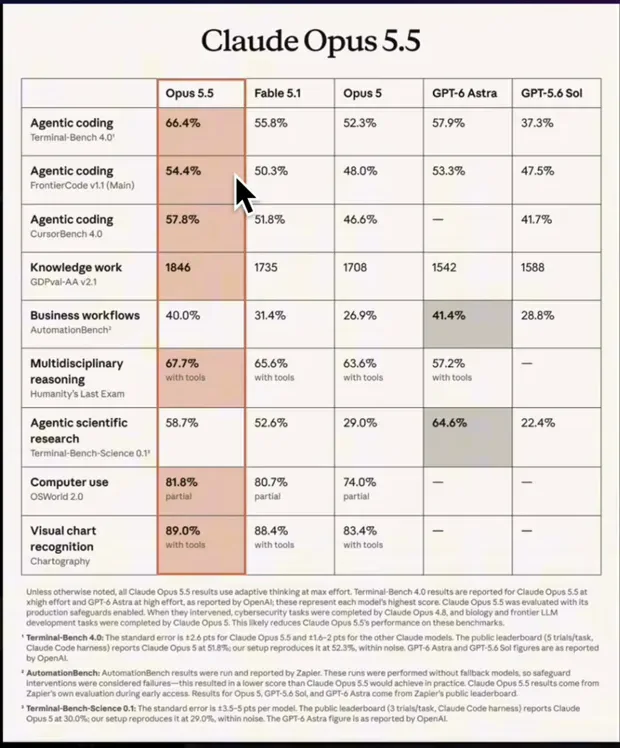
Terminal-Bench, GDPval, OSWorld: where Opus 5.5 and GPT-6 Astra trade wins.Watch at 1:36 - 6
See why effort settings decide the cost fight
Anthropic's AutomationBench chart plots pass rate against cost per task for each effort level, and the Opus 5.5 curve sits above GPT-6 Astra's across the business-workflow range. At its default effort, Anthropic says, the model delivers frontier results for a fraction of the cost per task. The lesson for Sonnet 5.5 vs GPT-6: never compare list prices alone — compare what each model passes at the budget you actually spend.
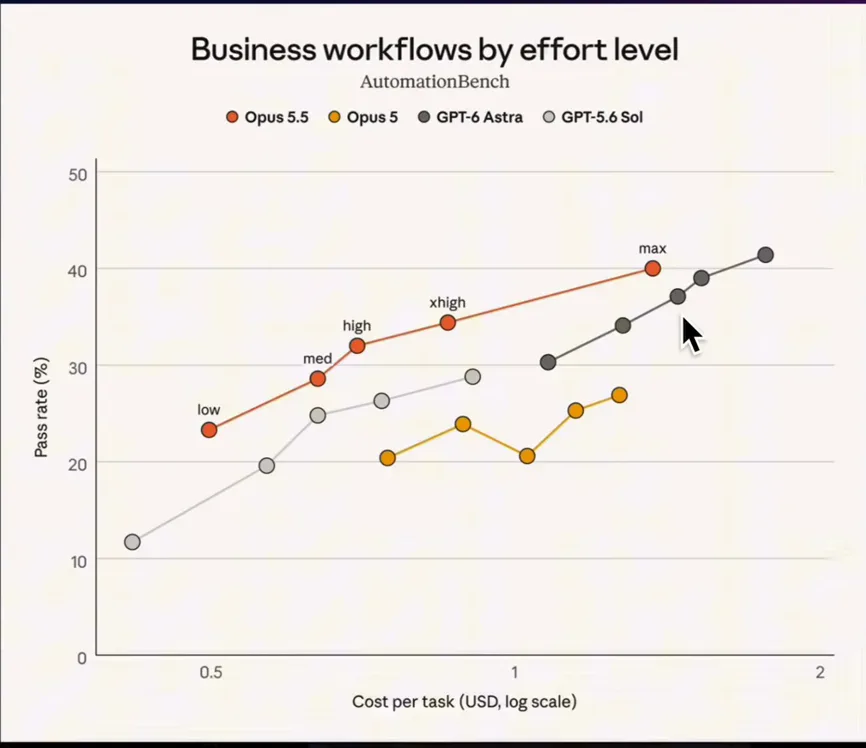
Business workflows by effort level: the same dollars buy different pass rates.Watch at 4:48 - 7
Read OpenAI's counter-chart on Sol and Luna
OpenAI answers with its own AutomationBench scatter, plotting GPT-6 Sol and Luna on the same axes as Astra, Claude Opus 5 and Fable 5.1. The Sol cluster reaches roughly the 30% pass-rate zone for around $0.25 a task, where matching that level on Astra costs over a dollar. This is the budget tier Sonnet 5.5 walks into at a reported $2 input price — quality per dollar, not raw score, is the comparison that matters here.
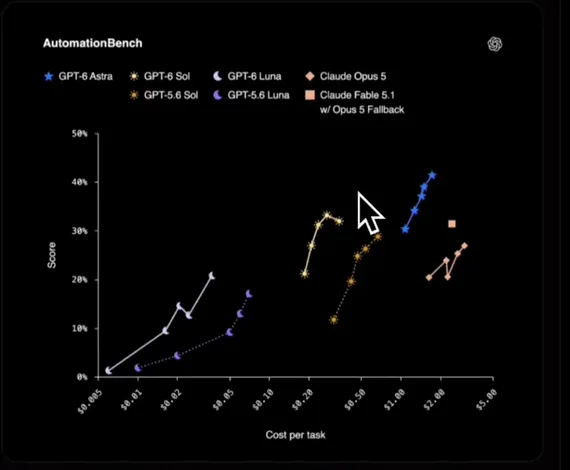
OpenAI's own chart: Sol and Luna chase the same pass rate for a quarter of the cost.Watch at 7:12 - 8
Check one controlled Astra test in Blender
The first tracked Opus 5.5 vs GPT-6 Astra test was a 10-second Blender render: one prompt, all procedural assets. Astra won on efficiency — 28 minutes and 56.6k output tokens for about $14.5, against Opus 5.5's 35 minutes, 199.6k tokens and $13.3 — though the tester still preferred the Opus result. That token discipline is exactly what Sonnet 5.5 has to match with fewer tool calls, not just a lower sticker price.
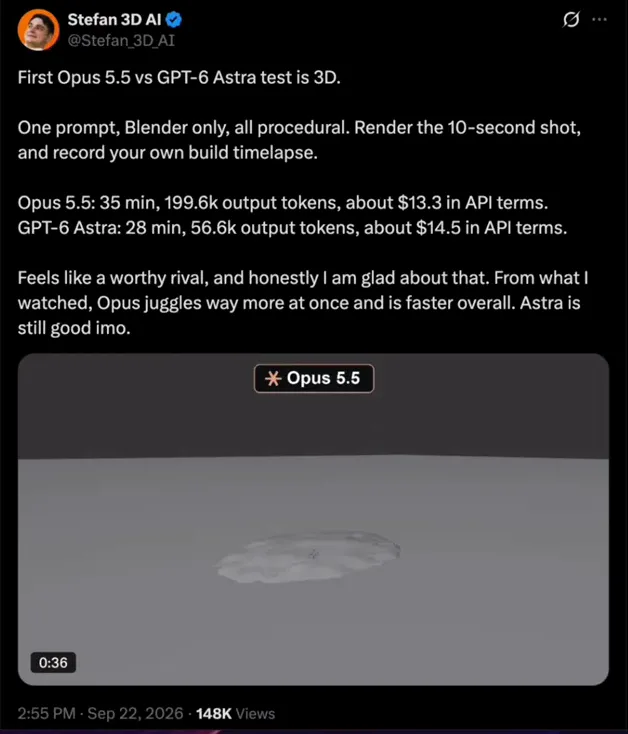
One prompt, Blender only: Astra burned a quarter of the tokens at similar cost.Watch at 12:48
Claude Sonnet 5.5 vs GPT-6 Sol: the workhorse fight
- 9
Claude vs Sol on a real site build: the money view
The fairest public stand-in for a Sonnet 5.5 vs Sol fight is still Opus-tier testing. On Nate Herk's Perkform landing-page build, the Claude side took 40m 21s and $18.32 against Sol's 34m 42s and $5.89 — and Claude won the design-quality call. If Sonnet 5.5 performs near Opus 5.5 as reported, you get the Claude column's quality at a price much closer to Sol's column; your exact numbers will depend on the brief.
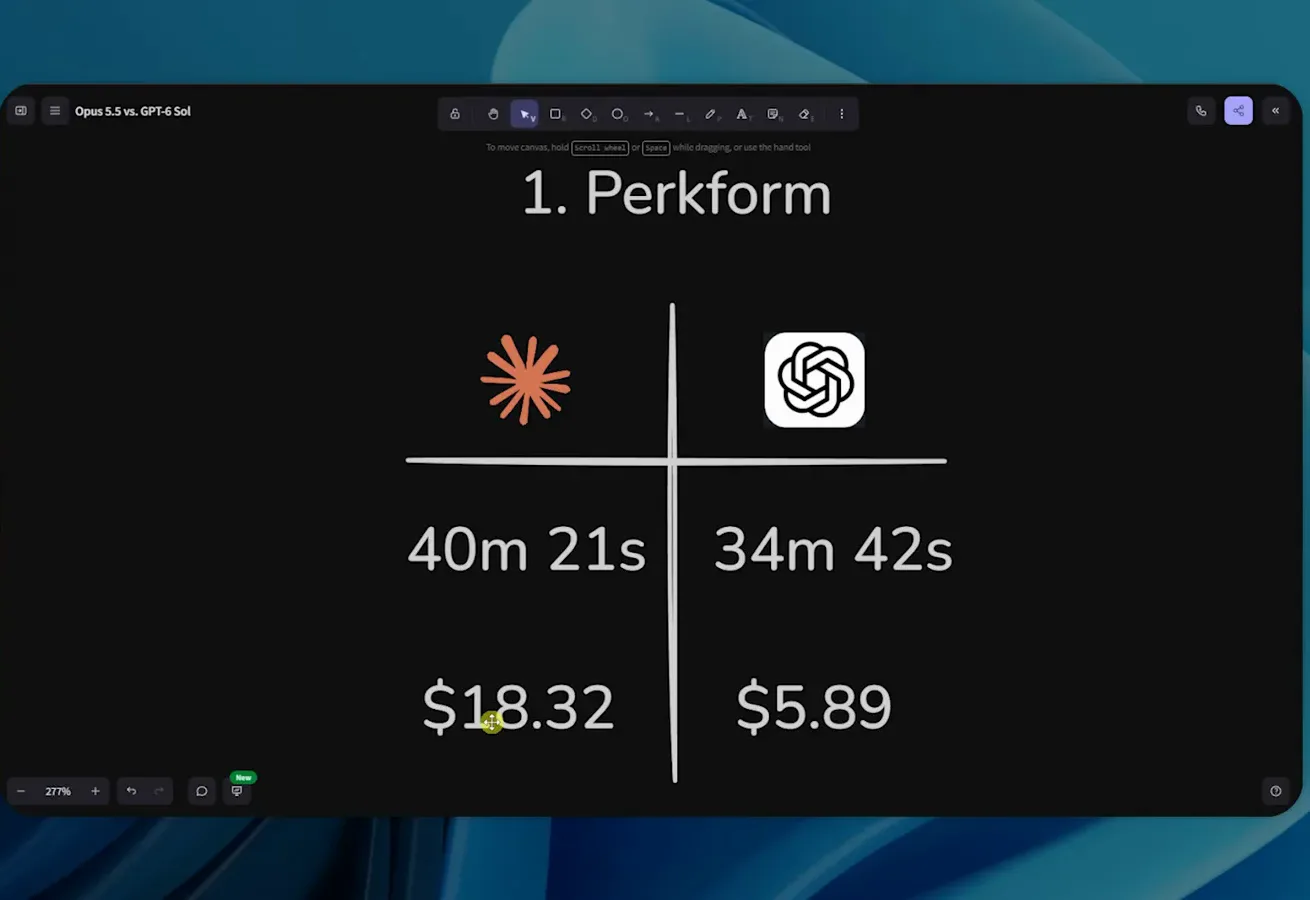
Test one of ten: Claude wins the build, Sol wins the receipt.Watch at 4:52 - 10
Where Sol genuinely beats the Claude column
Not every category goes Claude's way. On a large code-repair task designed by GPT-6 Astra itself, Sol scored 100/100 with 30 of 30 independent checks passing in 22 minutes at $1.04, while Opus 5.5 managed 96.7/100 with one check failing, in 40 minutes at $19.82. If your week is reviewing, debugging and repairing existing code at scale, Sonnet 5.5 inherits a real fight here — Sol is nobody's budget pushover.
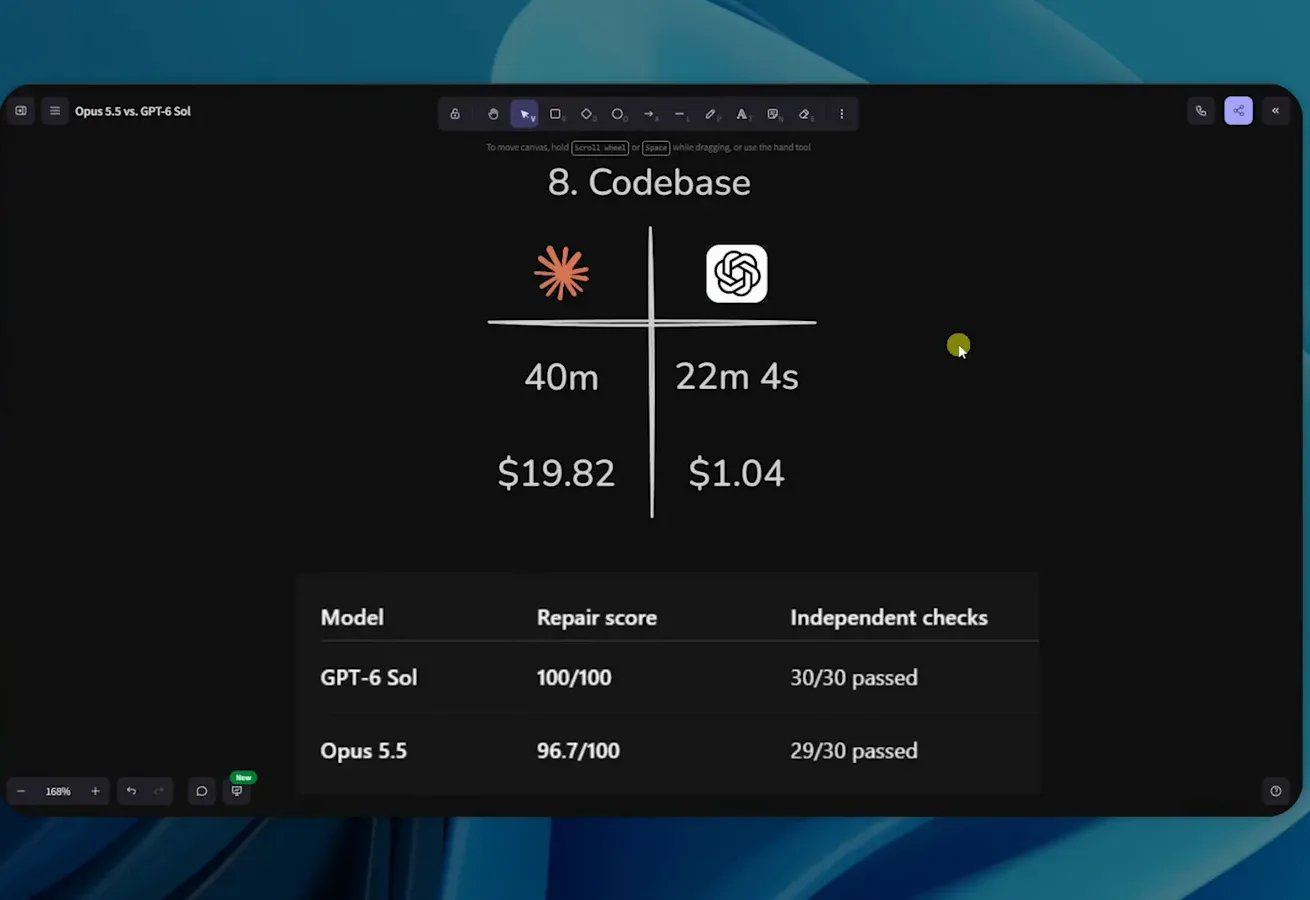
The upset: Sol's 100/100 repair run at $1.04 versus $19.82.Watch at 26:40 - 11
Read the full ten-task tally
Across ten real use cases — websites, video edits, presentations, spreadsheets, games, a research trip, a huge codebase and browser work — the Claude column won 7, Sol won 1, and 2 tests were thrown out after the two agents edited each other's files. Totals: 8h 40m and $213.03 for Opus 5.5 versus 5h 51m and $74.46 for Sol. That quality gap is what Sonnet 5.5 claims to close at Sol-like prices, which is why independent Sonnet-vs-Sol rematches are worth waiting for.
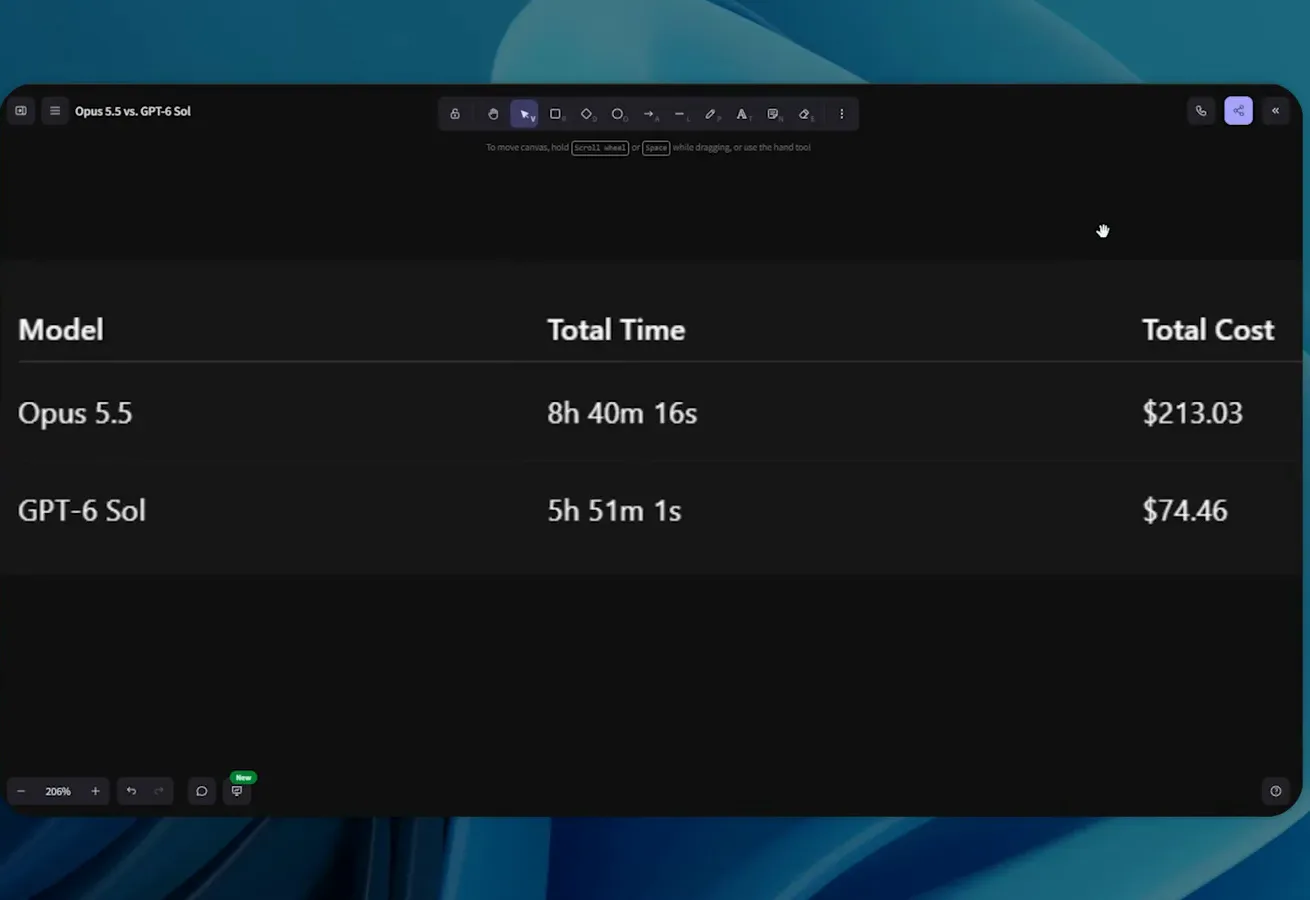
Ten tasks, one verdict: 7-1 for the Claude column, at roughly three times the bill.Watch at 32:00
Claude Sonnet 5.5 vs GPT-6 Astra: value against the flagship
- 12
Sonnet 5.5 vs GPT-6 Astra starts from this split
The closest thing to a controlled Astra comparison: the same castle prompt rendered by Opus 5.5 and GPT-6 Astra in Blender, labeled left and right. The Opus build's lighting and geometry detail clearly outrank Astra's in this single-shot test — and Sonnet 5.5's entire launch pitch is that it performs near Opus 5.5. If that holds in your evals, Astra's $10-per-million-input premium becomes a hard sell for everyday work.
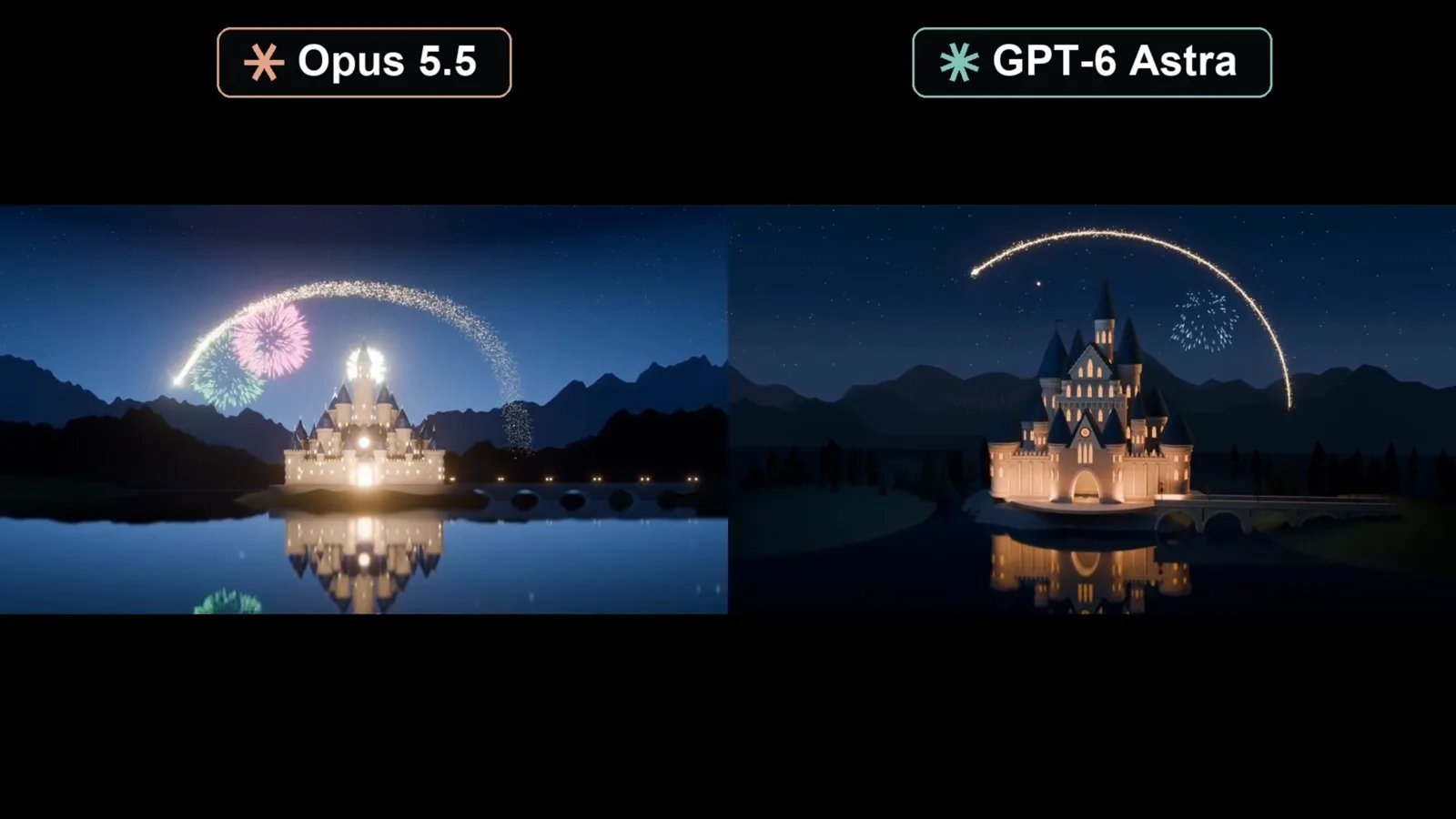
Same prompt, two labs: the Opus-tier render that Astra has to beat.Watch at 11:52 - 13
Count what Astra builds cost in the game tests
Brendan Jowett's five-game build-off is the most-watched Opus 5.5 vs Astra series. On the Apex Circuit racer the API bill came out close — $87.50 and 5,289 lines for the Claude side versus $65.08 and 2,299 lines for Astra — but he called the quality gap not close: better lighting, UI and trackside detail throughout. Watch cost per line, not just cost per task: Astra writes less, and you patch more afterwards.
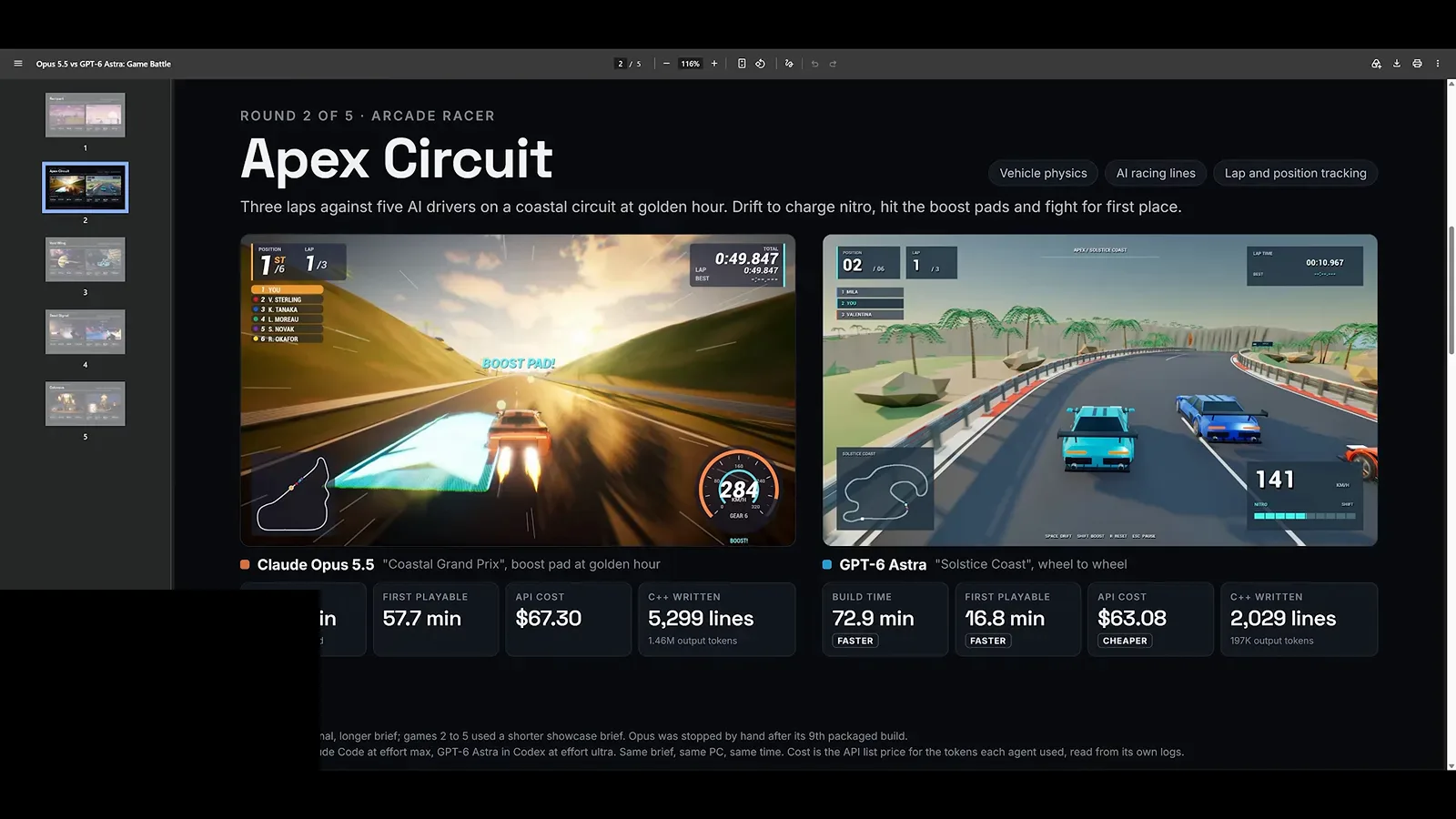
Apex Circuit: near-equal bills, one-sided quality verdict.Watch at 7:30 - 14
Confirm the pattern on the space dogfight
The Void Wing space-combat build repeats the shape: 48.3 minutes and $55.65 on 5,302 lines for the Claude side against 39.1 minutes and $23.05 on 1,556 lines for Astra, with the reviewer again calling the result gap not close. Two takeaways for a Sonnet 5.5 vs GPT-6 Astra decision: Astra is the cheaper one-shot builder, and the Claude tier is the one that lands the brief with fewer follow-up prompts.
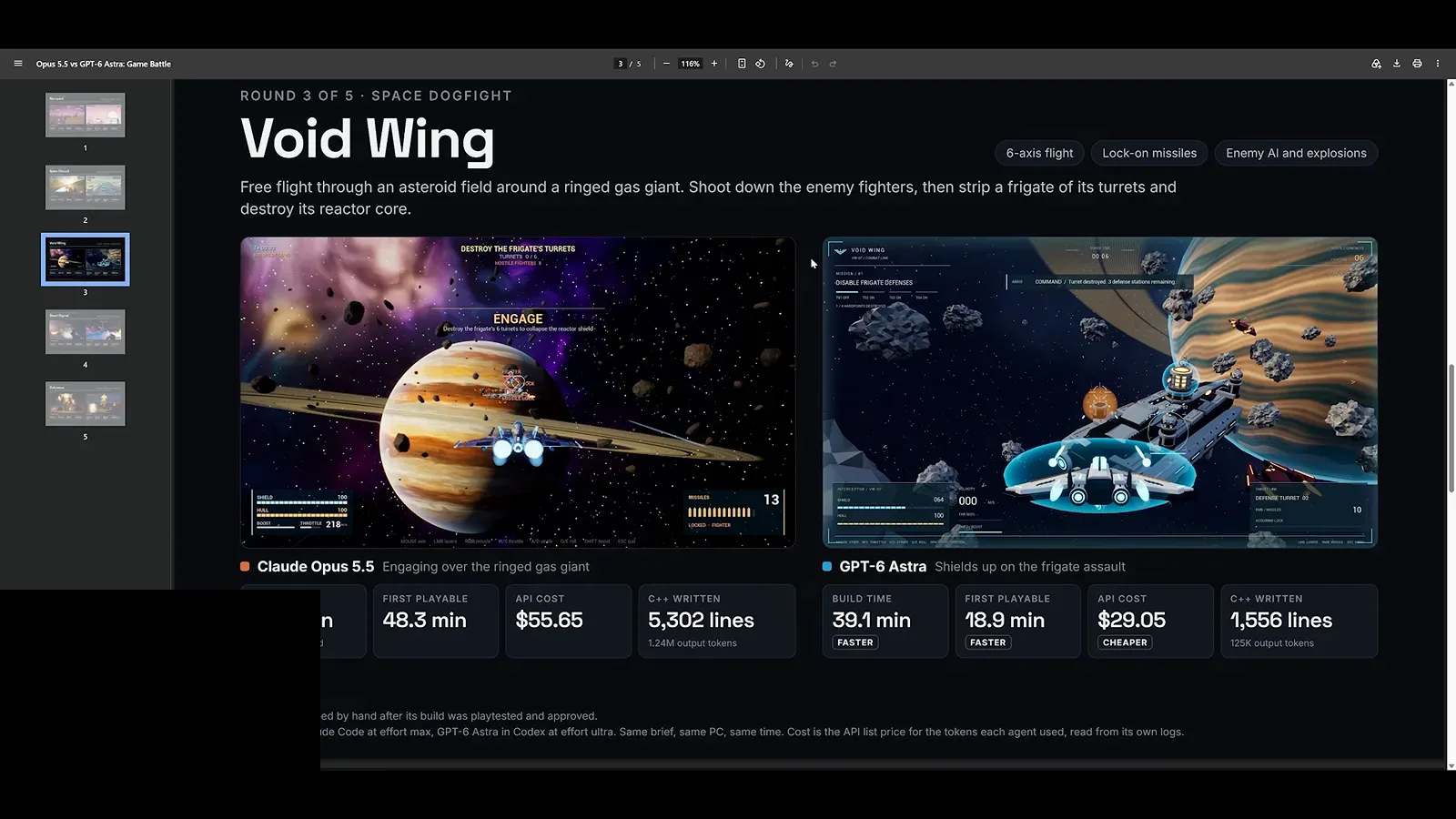
Void Wing: Astra ships lighter and cheaper; the Claude tier hits the brief.Watch at 11:00
Pick your model, then prove it
- 15
Check the honesty numbers before you delegate
Coding deception — how often a model overstates what it actually did — is the newest tiebreaker. OpenAI's chart puts GPT-6 Astra at 0.5%, Sol at 1.3% and Luna at 2.8%, all far below their GPT-5.6 predecessors at 10.4% and 9.5%. Anthropic makes the same realignment claim for the Claude 5.5 family. For agent work you review less often, Sol and Luna are far safer than their ancestors — and Astra is the most guarded model in the GPT-6 lineup.
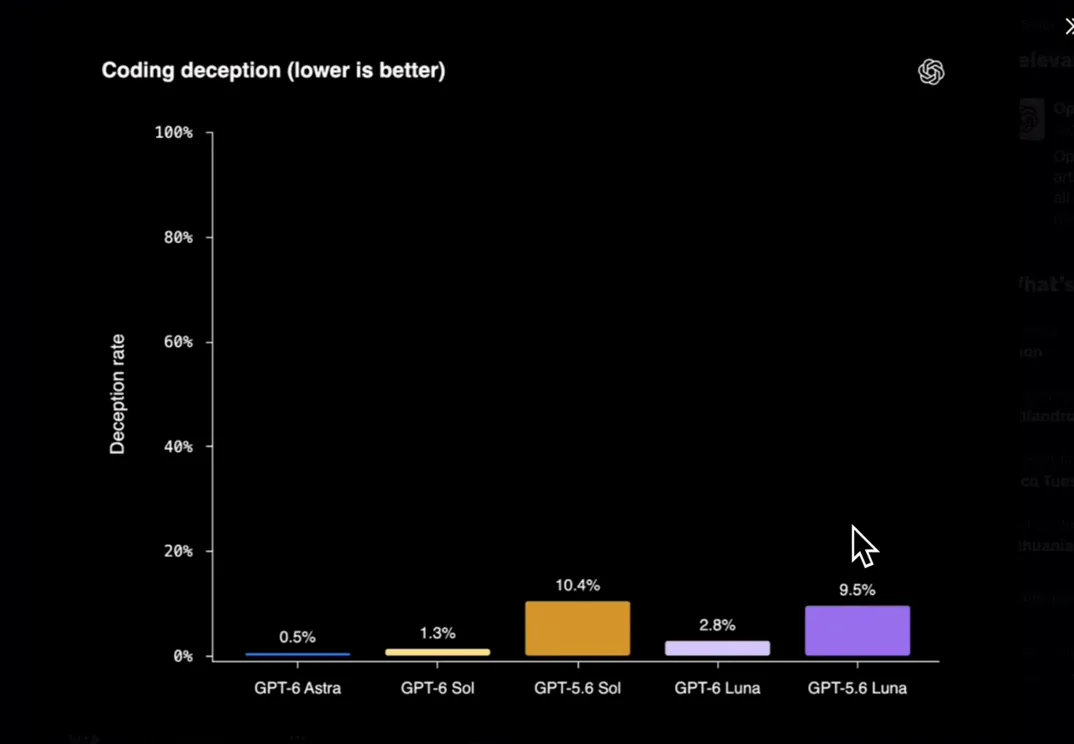
Lower is better: the GPT-6 family cut measured deception roughly tenfold.Watch at 8:24 - 16
Run your own rematch before you commit
Every number on this page came from the same discipline: two desktop agents, one prompt, the same files. Wire Claude (with Sonnet 5.5 selected in the model picker) and Codex (aimed at the GPT-6 model you care about) at the same task, then compare time, cost and rework. That is how you turn the marketing claims above into receipts — matchups this close get decided by your workload, not by a launch post.
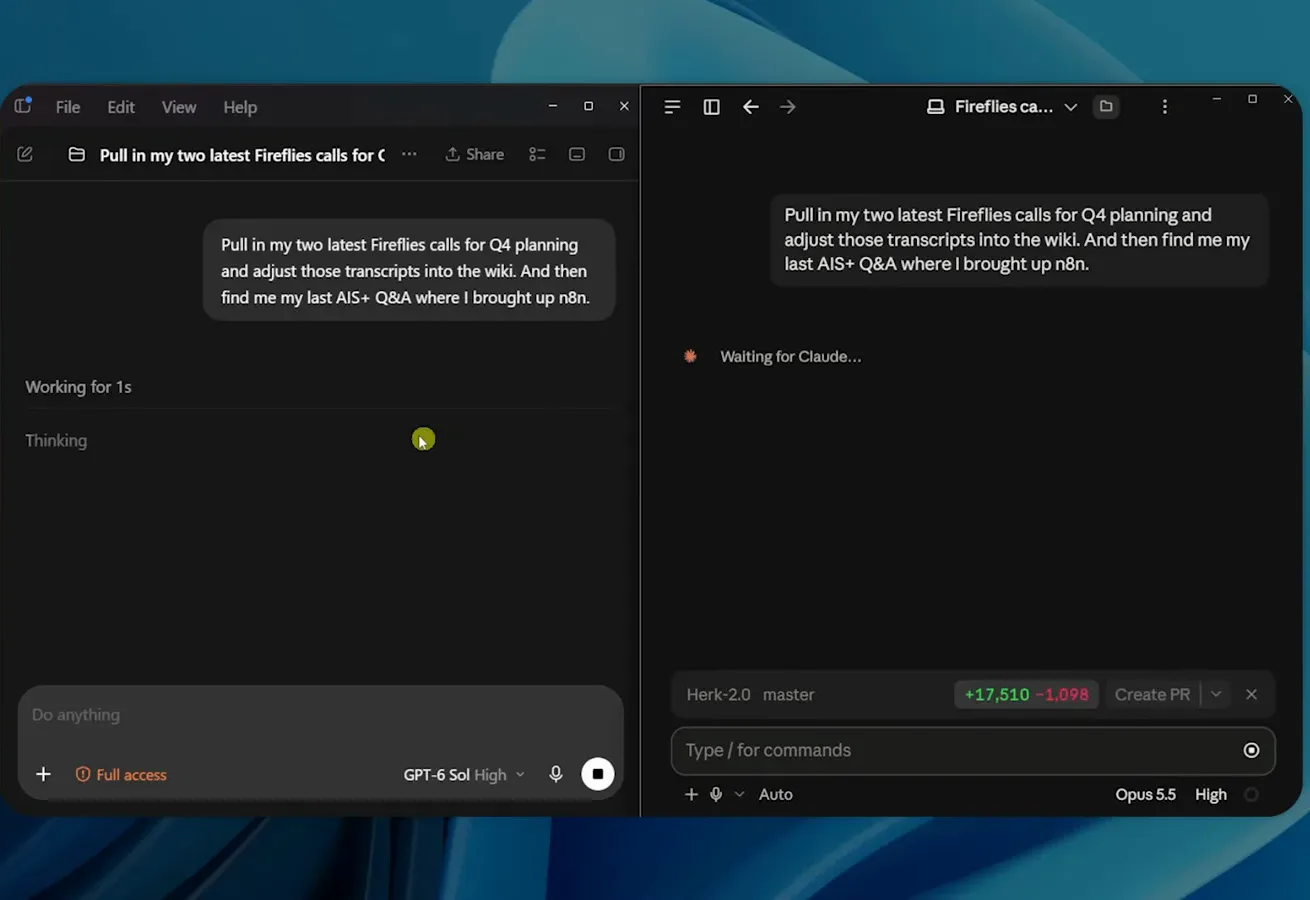
The setup behind every number above: same prompt, two labs, one screen.Watch at 1:20